Showing posts with label poor choices. Show all posts

Tuesday, May 25, 2021

STOP

Lacking motivation? Exhausted? Hit a plateau? INJURED??

THEN STOP.

What you're doing isn't working.

Take a step back and look at the last few weeks, last few months, whatever it takes, to find the culprit of your struggles. Don't tell me it's the weather. It's not summer yet.

I know why I'm sometimes struggling. I'm on the right track and I hope to fix it permanently soon. Or until I do the next dumb thing. I'm a runner, after all. 

I saw a couple posts by runners who I follow on Instagram and it got me thinking about this issue I see time and time again from me and my running buddies/social media influences. The constant struggle to get through a training cycle unscathed....it's a big problem! Been there, done that. Tired of it. Tired of seeing it from others, too. (harsh, yes, I know)

This particular post pointed out the four things that you need to become faster, but it also totally applies to the concept of STAYING HEALTHY, both mentally and physically, in a training cycle. I've adapted it with a few extra points:
  • 80% easy running (typically not what you *think* is slow, but SLOWER)
  • 20% hard running (and NEVER on consecutive days)
  • Consistency
  • Specified training (every run has a purpose, every small step is part of the big picture)
The second post I saw is a quote from the Growth Equation:
Peak performance does not result from heroic efforts. It results from consistent small steps that compound over time.


So which part is your weakness? 

Do you know what 80% easy looks like? It means that out of 5-6 days per week of running, perhaps 50 miles per week, only 10 of those miles, or maybe 2 of the days, are at a hard effort. Hard effort is Zone 4+, maybe still high zone 3 if you're like me and the gears take awhile to heat up as I get more fit, or because your specified training calls for marathon pace and that might not necessarily get you to Zone 4 right away. Easy effort is Zone 1-2. Zone 3 can be the gray zone and when you have more Zone 3 than Zones 1-2, you're in trouble. 

That 20% of hard running should never be on consecutive days. 48 hours or more between hard efforts. Easy miles or rest in between. Your body CRAVES easy miles to build your aerobic engine and allow your body to recover instead of becoming overly fatigued, leading to bad form and injuries. 

I recently wrote up my marathon training plan for this next cycle and once I hit 6 days per week of running, this is how my week will shape up:

  • Mon: Recovery Run
  • Tues: Intervals (always with a warm up and cooldown)
  • Wed: Easy Run (and long-ish)
  • Thurs: Tempo Run (always with a warm up and cooldown)
  • Fri: Off
  • Sat: Easy Run
  • Sun: Long Run (with race pace miles incorporated every 2-3 weeks)
Lots of easy paced stuff throughout the week.

Matt Fitzgerald explains all of this so thoroughly and much more eloquently than I ever could in his book, "80/20 Running." 

CONSISTENCY is a big BIG problem for a lot of people. You run a couple days one week, or take a whole week off, for whatever reason, then jump right back into 30 miles per week for a couple weeks, then take more time off. You can't stick to a training plan if your life depended on it. You can't commit to running on specific days, thinking it's okay to push things off a day or two, and then try to play catch up. JUST NO. Be committed and consistent, and if you have to take time off, ease into things. My first two weeks back after my 15 weeks off running after my surgery involved less than 10 miles of running. I still only run 25-30 miles per week and it's been nearly 4 months since my return to running. 

Specified training is just that. SPECIFIC runs on specific days, each with a specific purpose to build upon your overall fitness and lead you to the start line healthy and fit. Easy runs to build your base and aerobic endurance without overtaxing your body, recovery runs to recover from hard efforts while continue to add volume and endurance, long runs to increase endurance and your confidence in longer races, interval workouts to develop speed and efficiency, tempo runs to improve lactate threshold....you get the idea. Include a variety of running into your plan, in an appropriate schedule, and your fitness and speed and health will gradually improve....injury free. 

There are countless pace calculators out there to help you determine appropriate pace zones, calculators to help with heart rate zones, charts based on effort if heart rate zones aren't your thing. The point is, everyone should understand what their individual easy pace range is (hint, it's not marathon pace but rather MUCH slower). Everyone should understand their current fitness and adapt accordingly. Everyone has the ability to make up a schedule and stick to it. 

Coming off of an injury and getting right back into regular hard workouts and high volume, or running through an injury, is not smart nor is it heroic. I've only run 10 miles straight once since my return. I haven't run over 30 miles per week. I am chipping away at each baby step as it comes, knowing that each step creates big gains overall. Everyone should understand that big leaps can lead to big falls, that the turtle really can win the race.

Are you seeing gains? Or are you feeling overly fatigued and have nagging injuries? Then stop what you're doing, reassess where you can make positive changes, and set the wheels in motion.


Thursday, December 10, 2020

It's been awhile

 This is the first time in over 7 weeks that I have felt comfortable using both hands to type, so I got the urge to actually write a blog post for the first time since August. You see, on October 18, on an easy 10 mile training run with my husband, I tripped on something and fell hard on my right shoulder and completely destroyed my rotator cuff. And when I say "completely destroyed," I mean DESTROYED to the point that I couldn't move my arm at all after I fell. I was immobilized on the ground, in severe pain, and terrified. My arm literally couldn't move. I didn't know what I did...break it?...but I knew it was bad. Very very bad. And I needed to get to the ER as soon as possible.

That was a supremely shitty day. An MRI a couple days later confirmed my doctor's suspicion. I had a complete rotator cuff tear. There are four sections to the rotator cuff and I had torn two completely and one partially. Only the front and a small part of the back was still attached. It was no wonder that I couldn't use my arm...nothing was attached to make it move. It was a useless appendage and I needed surgery right away.

I'm also right-handed. And I was in the middle of home improvement projects, with a bathroom partially painted and three other rooms and some of the outside of the house ready to be repainted as well. 

Oh, and there was also that marathon I was deep in the middle of training for, only eight weeks away. Well, that wasn't happening anymore! When you tear your rotator cuff and get it surgically repaired, you don't run EVER AT ALL...for months.

Staring at my injured shoulder was depressing. I had pretty nice shoulders before this, I was strong, I never had a single shoulder issue in my life. Now I had a swollen, flabby arm that wouldn't work and wouldn't look the same for a really long time. The strong body that I had taken such good care of for years was now going to be suffering. Perhaps that's a vanity moment, I don't know, but it seriously bummed me out to think about.

I had surgery ten days after the injury, and it was only my second major surgery in my life. I thought I was prepared for how brutal it was going to be, after talking to a few friends who'd had rotator cuff repair (although none had as bad of a tear as me), but I was not prepared. It was awful and I want to forget it. The three days post-op, when I was completely dependent upon my husband to do anything, when I had a nerve block stuck in my neck, when my right arm was totally numb, when I couldn't shower, when the smallest movement caused major discomfort, when I was totally drugged up on hydrocodone just so I could sleep....that was a hideous three days.

I had to wear my sling for six weeks and couldn't start physical therapy until then (in talking to my friends, it seems like that's a very long time to have to wait for PT, but I have a shit ton of anchors holding my repair together and it needed to heal). Once I could do a few movements on my own at home two weeks post-op, I started feeling a little bit better, although it scared me at first to see how little movement I could endure. I couldn't even write without major discomfort and I had to do learn how to do everything with my left hand. I couldn't style my hair, so it hasn't exactly looked so great the last few weeks! I can't drive my own car since it's a standard, so I steal my poor husband's (nicer) car, but driving one armed is not easy. Every few days, however, I do notice a little more range of motion and it gives me hope. I can now do a few things, carefully, with my right arm and hand and it has given me a bit more freedom. Physical therapy started yesterday and I have a lot of exercises to do a few times per day. I'll be going to PT twice a week for now. 

One of the worst parts of my accident is that it happened a month after my husband got laid off from Dell (big company-wide layoff). The timing couldn't have been worse. He had a lot of good things in the pipeline job-wise, but he still was unemployed and taking on thousands of dollars in medical costs was not exactly a good thing. I felt terrible for doing this to our family at the worst possible time. The silver lining was that while I recovered right after surgery, he was able to be a full-time nurse. The morning of the surgery, while we were literally in the parking lot about to walk in to the facility, he got a call with a job offer, and REALLY great job offer, and it couldn't have come at a better time. Twelve days after my surgery was his first day at work (from home, thankfully). He's incredibly busy so I have had to be pretty resourceful around the house using only one arm. He just doesn't have free time for anything right now, but there's a paycheck again, so it's all worth it.

Having to defer my marathon entry to next year and push off Chicago until 2022 (I won't be ready next October) was deflating. I was looking forward to getting back to Mississippi to run along the Gulf again, I was running very well and feeling good. However, I knew that even if I did get another BQ, I wouldn't be using it for Boston next year. The race will (maybe) be in September instead of April and I have no desire to run it in September. So that leaves my next likely Boston opportunity pushed out to 2023 and that's a long shot. It made me realize that in all likelihood, the soonest I can get back into BQ shape would be during the Boston 2024 qualification window (that's when Chicago 2022 would be)....and that means a new age group! I never thought it would take that long, but it just might! I have no idea when I will be allowed to run again, and I'm scared to try it. I'm fearful that I will think I'm going to trip again. I can't hurt myself again and still expect to be able to have full use of my arm. I simply can't. It may take a very long time to get back to where I was pre-injury. 

In the meantime, I walk a lot. Almost every day. It's a point of sanity in my day that I desperately need. But I miss the early morning runs and how strong it made me feel. I'm very much out of shape now, feeling pretty down about my body. I have to find the patience to get through the next six months (and beyond). Turning 47 next month makes me feel like I time is not on my side. 

Also, coronavirus can go to hell.

Tuesday, August 7, 2018

Boston Bound times two

 "Marathons are stupid. I repeat, MARATHONS ARE STUPID. Now that I've got my first marathon under my belt, I can certifiably confirm that they are stupid." - Greg Hahn

My husband ran his first marathon, and I think he's now wishing it was also his last. But since he qualified for Boston with a pretty significant cushion, he's now going to tackle that course with me.

This whole idea of his began when I finished Mississippi Gulf Coast Marathon in December. He decided he wanted to run Boston with me, and that meant he needed to qualify as well. He had very little long distance racing experience, and no marathons, but he's really fast. It was going to be a crazy journey, that's for sure!

I wrote him a plan and it wasn't easy at all. I didn't approach it like I would a first time marathoner. I approached it like it was for someone with one shot to make it to Boston. He wanted it that way, so that's how we did it. Six months with gradual base building, speed and endurance building, and a few shorter races to gauge fitness. 900 miles later, he made it to the start line on July 29 in Snoqualmie Pass, Washington.

Preparing properly a few days prior at Edna Valley Vineyards, with a chicken friend

Drove up the Pacific Coast Highway en route to San Jose to then fly to Seattle

Packet Pickup!
Race Start
Checking out the finish line

He didn't have as many nerves before race day as I would've expected. He was definitely eager to get it done. As we drove the 40 miles to the race start that morning, he grew more anxious. He explained his mentality like this:
Mentality of actual race day is just like any other competitive sport. It's game time. Go out and do what you trained to do. That's what you put in all the work for.
This attitude definitely helped him control the anxiety.


Ready as he'll ever be!

He chose a race along the Iron Horse and Snoqualmie trails, so unfortunately because of the difficulty in accessing the course, I wouldn't be able to see him many times during the race. We scouted out the route the day before to be sure I knew where I was going and it was planned for me to see him at the halfway point and around 21 miles and then hightail it to the finish line.


The race start. I didn't capture Greg, but I did get a pic of my friend Bill (in yellow)

He felt great for most of the race. I was worried the heat and humidity would deplete him sooner than expected. Temps at the start were a muggy 65 degrees and would climb to well over 70 before he was done. He kept focusing on the fact that it was still 15 degrees cooler than all his training runs. Sure enough, he was fine with the weather and shot through 13.1 in just under 1:38, a 5 minute PR at that distance. His BQ time is 3:25, and his goal was 3:20, so he was doing great. Needing a 1:42-1:47 in the second half was really awesome.

In order to get to the next checkpoint at 21 miles, I first needed to run down a 1.2 mile steep dirt road. Luckily when I arrived at the road to head up to the trail, I got to hitch a ride with a volunteer firefighter so I didn't have to climb up the road too much. Not so lucky on the way down, but I made it to the next point with plenty of time to spare. I was definitely noticing how hot it was getting outside and was genuinely worried for Greg.

The road leading to 13.1 mile checkpoint
My cool ride up the hill
Coming into the 13.1 aid station


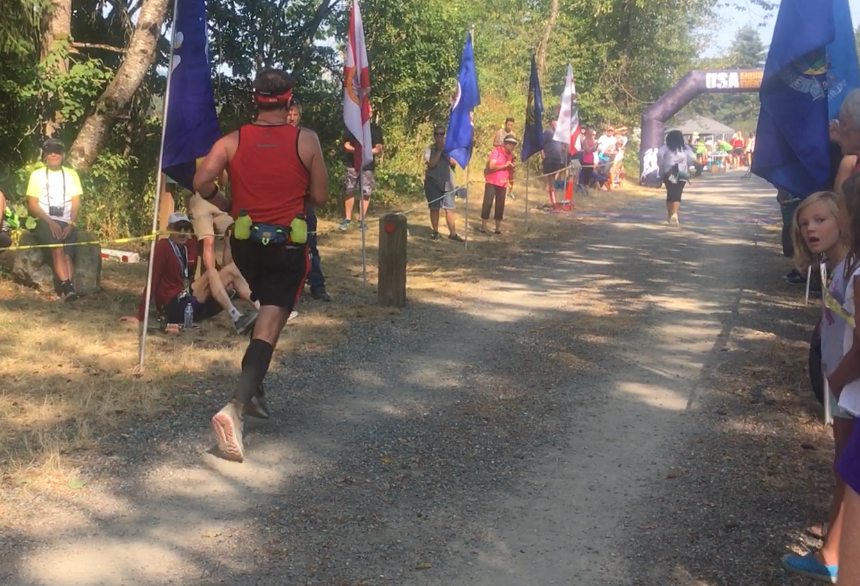
I tracked him via his phone location and knew he was still right on pace and sure enough, at 2:40 into the race, I saw him. I was positioned on the trail at about 21.3 miles. He looked so strong still and I screamed my head off, jumped up and down like a lunatic, told him I loved him and to not slow down and got it all on video.


Moving so fast, he's blurry


Less than five more miles!!

At this point, I was an absolute nervous wreck. I know how marathons feel and the next half hour for him was going to be excruciating. He had time in the bank (he was definitely running balls-to-the-wall) and could slow down and still run a 3:20 but I was still stressed out for him. This whole marathon sherpa thing is a lot harder than you'd think! Especially on unfamiliar roads and dirt trails.

I made it to the finish line with 20 minutes to spare. I religiously checked his location and it showed me he was still doing just fine. He probably wanted to die but he still appeared to be running a good enough pace. Waiting those last 20 minutes at the line and hearing the announcer cheer for all the finishers hitting BQs was only serving to make my heart rate go up higher. At this point I knew Greg was going to do it. It just remained to be seen just how big of a qualifying time cushion he could get.

Waiting at the finish

Seeing him coming through to the finish was probably one of the best moments ever, despite the fact that I could definitely tell at that point that he wanted to die. There's no sugar coating it - he looked pretty depleted!


He finished in 3:20:17, which is 4:43 under his qualifying time. SO close to that 5 minutes that he needed to register at the same time as me, but still a really comfortable cushion.


My husband was a Boston Qualified Marathon Finisher!

Thank God that was over.

But now I genuinely was worried about him. He was feeling awful and he looked even worse (sorry, honey). He found a lounger to rest on at the medical tent and was pretty much not functional for several minutes. A crapload of water, Gatorade, and Muscle Milk helped. A paramedic came over and was concerned and wanted to be sure he was ok.

That conversation went something like this:

Greg: Can I have an IV?
Paramedic:  We'd have to take you to the hospital
Greg: I'm good. I don't need an IV.
That's the paramedic in the background

He made his ankle bloody

He was so glad it was over. He also told me over and over that marathons were stupid and maybe he wouldn't actually register for Boston after all because that would mean running another marathon and marathons are stupid. He has since come to terms with running one more, but for awhile there I really thought he'd forgo actually running Boston! The fact that he'd be running much slower with me helped him come to his senses.

We've spent so much time talking about how he executed the race and I seriously could not be prouder of him. Before the race, I coached him on the mental side of the last 10K, and those lessons coupled with his past athletic pursuits got him through the worst part of the race.

He started feeling the fatigue at 20 miles and his pace slowed slightly but he was ahead of pace so he allowed his body the break. It got really difficult at 24 miles and the final part of the race was excruciating for him. I asked him how he got through it.

He focused on what he had left and not what he had already done. "Anyone can run 6...5...4...3 miles" is what he told himself.

The slowdown in the final few miles didn't worry him because he was ahead of pace. He kept calculating that he only needed 9 minute miles toward the end and he would still qualify. This made it less daunting.

People were dropping like flies, but rather than let that mess with his head, it gave him greater resolve to keep pushing and not walk.

He kept reminding himself that he didn't push this hard, train that long, and endure that much pain in the race to just give up at that point.

He might as well be destroyed and hit his goal and feel the accomplishment rather than the letdown. 

He didn't want to disappoint me. (I assured him that he could never disappoint me no matter what the clock said in the end.) 

It's not often that one qualifies for Boston on their first marathon finish, and I'm so glad my husband was a big enough badass to do just that. He did it so he could run a prestigious marathon with me and I think that is just about the sweetest thing ever.

I'll keep him.

Post race recovery
Touring Seattle the day after
Got to see my niece!


Tuesday, October 17, 2017

All the Colors

You know what? I am so tired of summer weather.

It's October, so you'd think I'd be in the clear, but nope. Texas hates me!

We got some great temps during the week last week, and the last two mornings have been spectacularly perfect running weather. But Sunday morning? 70s and 100% humidity with the threat of thunderstorms. Also? Race Day!

For crying out loud.

Of course, I conveniently forgot that on the same exact weekend last year, I ran a half marathon in Central Texas, in the same exact weather conditions. And it was my second worst road half marathon finish ever. Fun times.

But, being the badass that I believe myself to be this year, that wasn't going to stop me from running that damn race. Was I going for a PR? OH HELL NO. The race course was 900 feet of elevation gain over 20 different hills and inclines, so a PR was a long shot anyway, plus I had decided running that far under my marathon pace for nearly two hours probably wasn't a wise choice. The weather made that decision much much easier to take.

The plan, after careful consideration and lots of feedback from friends, became pretty comical actually.

NO WATCH.

WEAR A COSTUME.

FIND A CHALLENGING PACE, BUT NOT TOO CHALLENGING.

MAKE IT A TRAINING RUN.

SCREW THE WEATHER.

HAVE FUN.

That, my friends, is exactly what I did! I showed up to that miserable race in all the damn colors. Rainbow zebra sports bra, rainbow tutu, rainbow compression sleeves, rainbow kinesiology tape, bright shoes, bright hat, no worries.


I was a big fat rainbow about to run my very first tutu race. Luckily I had friendly faces all around me, as several friends were out there to run as well. Nobody was "racing" it, which made my decision even easier to take.

I was quite happy to see I wasn't the most ridiculous looking person there. Close, but not quite. After all, there were dudes dressed as unicorns. Winning!


Despite the fact that I knew I wasn't running super hard, I was nervous anyway. I wasn't wearing a watch, so my new fear became running slower than it felt and totally embarrassing myself with a slow time that would be online forever. To hopefully prevent this from happening, I positioned myself at the start with the 2:00 and 2:10 pacers (thank you, baby Jesus, for there being pacers to sort of help me keep track of my mediocrity). I wanted to be sure I didn't start out as fast as the 2:00 pacer, but never allowed the 2:10 pacer to pass me. A 2:05-ish time seemed reasonable to me. Faster than a usual long run, but not so hard that I couldn't recover quickly. Embarrassingly far off my PR pace, but it is what it is. Is "embarrassingly" even a word?

So it started off without much fanfare. I found a decent pace that wasn't hard, got into a bit of a groove for that first mile. A group of girls near me were talking about the course, and I made the mistake of mentioning hills. They actually asked, "there are lots of hills?" Oh, dear, were they in for a surprise.

By the time I saw Greg at the two mile mark I'd already run up three of the damn hills, but I still felt really good. Of course I did....I was only two miles into a 13.1 mile run. If you don't feel good then, you're really screwed. But in all seriousness, I felt just fine. This was pace I could keep doing, whatever pace it was....but I actually had no clue because I wasn't wearing a watch. A girl running with me for a few miles almost blurted out how long we'd been running, but I told her NOOOOOOO. I didn't want to freak myself out if I was running too fast or too slow. I had found my groove and I wanted to hold onto it for dear life.


Years ago Greg ran a half marathon on this course, actually the only one he ran at race pace because all his other half marathons have been with me, a much slower runner. He still to this day is traumatized by the course, but I always rolled my eyes at him because I've run some pretty hard half marathons with just as much elevation gain. No way could this course be harder.

It's harder.

The damn hills WOULD NOT QUIT. See, I should know this because two of my triathlons were out here, and the bike portion was this exact course. I know the hills suck and they don't quit. But I always figured it would be easier to run on it than ride on it.

That's debatable.

It was right about the half way mark when I realized that this was getting a little difficult. My heart rate appeared to be under control, I wasn't breathing particularly heavy, my legs weren't fatigued, but I think my head was getting in the way of my badassery. When you start seeing practically every person walking up the hills, it starts to bug you (NO, I DID NOT WALK UP A SINGLE DAMN HILL). I think I was ready to be done. But I still had like six miles and eleventy billion hills to go. It was around this point that a tutu unicorn dude was leapfrogging with me, alternating running and walking. As I passed him during his walk break, I mentioned that it kinda sucked out there. His response was, "but at least we look good!" You know what? We did look good!

Greg always talked about the hill along the toll road as being particularly atrocious. I remember having an asthma attack on that hill during one of the triathlons, so the thought of this beast loomed over me as I approached it. But, I actually caught a break here. When I made the turn onto that road, I felt a breeze. It felt a little cooler out, and it made me so happy I got a second wind going up that hill. It really wasn't bad at all! I was badass again!

Until the next hill. Dammit.

I was being deliberately slow at the aid stations, taking a little bit of extra time to refill my water bottle. I didn't want to take too long and rack up too many extra seconds onto my finish time, but I also didn't want to run anymore, so it was a little bit of a mental battle.

Once I saw the 11 mile marker, I felt a little better (not physically, because give me a break, but mentally definitely better). My legs were now fatiguing and all the damn hills were catching up to me. That's actually probably really great that it took so long for my legs to start to feel the effects of the hills and it gave me a bit of a mental boost that technically I was holding up okay for it being the worst weather ever. I only had two miles to go and I thought I might even be able to speed up a little bit. Not that I would know, since I wasn't wearing a watch.

On one of the last turns, we got a headwind that was actually kind of strong. I had to hold onto my hat to keep it from flying off, and although the wind made it feel cooler and less humid, I wasn't particularly appreciative of it being in my face. I mean, seriously, can this race just be over now?

You have no idea how great it was to see the 12 mile marker and know that I actually really was ALMOST DONE. I was passing people! I was running faster! I wasn't having an asthma attack! And I was pretty sure I wasn't going to embarrass myself since the 2:10 pacer never caught me. I lost sight of the 2:00 pacer by mile 4 so I knew I was several minutes over that mark.

As I approached the finish line I caught sight of the clock and it said 2:05. THANK GOD. I was totally okay with a 2:05 on the books, especially since I actually, if I totally admitted it to myself, felt just fine. Ready to be done, but still very much in control of my run.


Still felt awfully refreshing to cross the finish line AND FINALLY BE DONE RUNNING. Then I drank all the water I could find and wanted to lay down in the grass and take a nap.

The morning, however, wasn't quite over. I discovered that I actually got 2nd place in my age group. Are you kidding me? I run a 2:05 half marathon and GET ON THE PODIUM? Were there like 3 people in my age group? (actually, there were 12 so I legit did well for my age in that particular race....go figure). Mediocre time or not, I was damn proud of that second place medal! First time ever that I have placed in a half marathon, and I was going to take it!

My two teammates who ran also got 2nd in their age groups, so it was a good day for Georgetown Triathletes and our "training runs."


The next morning it was 50 degrees out and 60% humidity. This morning? 46 degrees out. I ran a progressive tempo run this morning and totally killed it.

This coming weekend is my first of three 20-milers. The forecast? THUNDERSTORMS. Shoot me now.


Thursday, March 30, 2017

200 miles.....and Confusion

Not really sure where to start.

So I ran my 8th Texas Independence Relay this weekend. I committed to four legs for over 19 miles, plus the 1.15 mile prologue.

It was probably a poor choice to commit to that many miles, but we had several runners that were not 100% and I felt like I didn't have any nagging issues that could prevent me from being a workhorse over the course of the relay.

Well....

I blew up. I did all the miles I said I was going to do, and I averaged 9:31 pace over my four legs. But it should have been much faster and much easier for me. My last two legs were the two slowest legs I have ever run in all eight years of this relay, at 9:49 and 10:20 pace. I'm so disappointed in myself and so confused as to what went wrong.

Two days later, my legs feel pretty good. Although I had a bit of IT band tightness in the late hours of the relay, and my quads were unusually sore going into my fourth leg, I have recovered well and my IT band is giving me zero issues right now. I am, however, very sick with a cold that started coming on Sunday night. I don't want to make the excuse that I was coming down with something and that's why I suddenly couldn't run well anymore. I suppose it's possible, but it still frustrates me.

I ate well. I hydrated very well. I rested better than I expected during our break overnight. I don't think I was particularly tired or cranky.

I just totally blew up.

I ran 8:53 pace and 9:06 pace for my first two legs, and while it wasn't particularly easy to hold those paces, I was steady and determined and not overtaxed despite the warm weather. I had high hopes for the my third leg, which was at 1:00am in much cooler weather. Usually my overnight leg is my strongest and with it being only 4.13 miles I thought I might be able to run about 8:45 pace. But as soon as I started running it felt hard. I thought I was running around 9-9:15 pace but when my first mile came through it was an even 10:00. I tried speeding up in the second mile and it came in at 9:38. No way should this leg have been feeling this difficult, but I simply could not run any faster without it being a huge struggle. My van mates cheered me on when they checked on me, and all I could think of to say was "I'm running 10 minute miles and I don't know why!" They thought that was hilarious....but no. No it was not.

I wasn't the only one to struggle overnight. The humidity was getting very bad as the night progressed, although I didn't really notice it so much on my leg. The other van was feeling the effects of the weather and the miles and a couple of them needed to drop their fourth leg. I really had no choice but to suck it up for my 5 miler into downtown Houston. My legs were getting so stiff and I was honestly worried about being able to finish strong. We needed absolutely every strong mile we could get in those last legs of the relay. I wanted to do well for my team.

It was pretty ugly. I started off as conservative as I could to loosen up, but even a slow pace was hard. As the other van passed me to check on me, I told them I was running 10:30 pace and wasn't sure I could make my legs go any faster. They cared less than I did and just cheered me on.

I have never had the urge to walk on a relay leg more than I did right then, but I pushed through and forced my legs to keep running. As I crossed the pedestrian bridges over the bayou and could glimpse the skyscrapers of downtown it felt like they were so far away, even though it was less than three miles. This leg was taking so long to get through! For the first four miles I averaged about 10:15 pace but my fifth mile I slowed down considerably to 10:45 pace. I couldn't really pick it up very much when I turned the corner for the last minute of the run down Smith Street to the exchange.

The best way to describe my last leg was that it was every bit as hard as the last five miles in a difficult marathon, and the way I felt after I finished that last leg was exactly like how I feel coming down the finish chute after a marathon. I was completely spent, totally sore, unable to breathe, and miserable.

Thinking back on it now, two days later, and I'm still pretty perplexed as to what happened. Is it obvious I'm totally disappointed in myself?

I need to shake this disappointment and move on. My team did pretty well for having so many people struggling with injury and training problems, with it being in the mid-80s and sunny during the afternoon runs, and with having to shuffle some of the legs around. We finished earlier than expected (barely!) and nobody was really hurt (at least not anymore than when we started!), and we had a great time. But I always want to be a workhorse (even if I'm the slowest workhorse).

Good God, I need to shut up.

However, at the end of the day, the Texas Independence Relay is still the best race of the year, even if it's the most exasperating. Lots of great moments. Lots of crazy moments. Lots of moments that fall under the category of "what happens on the relay stays on the relay."


Sunday, January 10, 2016

Next Steps

Damn injuries.

It's my own fault. I knew it was coming. I tried to fix it before it got too bad. But I didn't rest. After all, I was signed up for races that I really wanted to complete. No regrets, but I'm still frustrated.

One of these races was the New Years Double. I would be doing the Double Double, which was four different races over 2 days, a 5K and either a half marathon or full marathon on each day. Since I'm only "half" crazy I went the Double Double Half route. I knew from the beginning that my times weren't going to be super speedy. I was training to finish these races, not set PR's. After all, it's 32.4 miles over 2 days and I'm not an ultra runner. That is some serious mileage for me.

In the months leading up to the race I just wasn't feeling like myself. I had also signed up for the Houston Marathon on January 17, but decided awhile back to drop to the half marathon. I felt sluggish, was under a lot of stress, had not been focused on strength training like I should have been, and just wasn't feeling like a full marathon was a smart choice. But I really wanted to complete the New Years Double. Running double long runs of no more than 12 miles wasn't intimidating to me like a single 20 miler would be, and in all honestly the training went fairly well. My times were slower than in recent years, but I was able to get through the long runs okay.

But I was having nagging pains that frustrated me. I assumed I was developing Achilles tendinitis, so I tried rolling, trigger point, and stretching and I kept most of the problems at bay. I was still nervous about how Day 2 of the New Years Double would go.

I got through the race. I finished. Day 2 was fairly ugly. The pain after Day 1 was pretty significant and I won't lie by saying I wasn't fearful my Achilles would snap in two during Day 2. It didn't, but at some points it sure felt like it might.

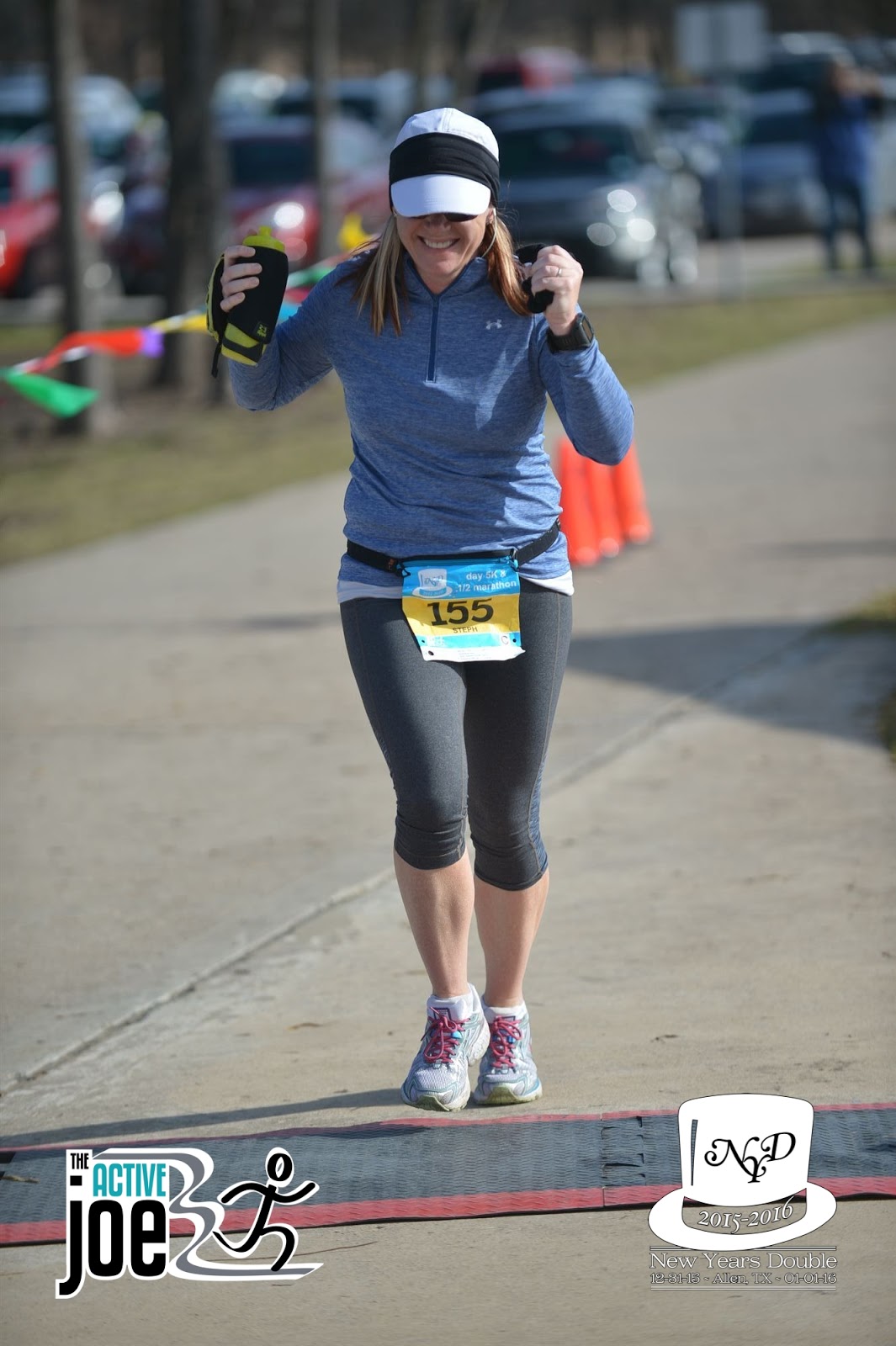
Day 1 I actually posted respectable times. The 5K was long due to a direction error by a volunteer and I'm pretty pleased with my 8:35 pace over 3.4 miles. My half marathon was 9:25 pace. But there was an incredible amount of discomfort after those races. I ran my slowest 5K ever on Day 2 (intentionally), and my second slowest half marathon. I decided that in order to reduce the impact to my heel, I would run for only 10 minutes at a time and then walk for 1 minute. This plan worked very well and my running pace was respectable. As the race progressed, my quads definitely started getting sore and it was harder and harder to start back up with running after my walk breaks, but my heel wasn't giving me a whole lot of trouble towards the end.

Did I mention it was brutally cold both days? And windy!

I made it through 33 miles and earned my Double Double medals. It remained to be seen at what cost, however.

Done with all four races

Eve race medals

My friend Melinda ran the same races as me


The day after the race was probably the worst as far as pain and swelling. I noticed, however, that the pain was more on the medial side of my heel rather than being right on my Achilles, and that worried me even more. If it was truly tendinitis I would assume my pain would be centered on the back side of my heel. So now I was worried about a stress fracture. Needless to say, I called my podiatrist and made an appointment.

Luckily, no fracture was detected on x-rays and based on the swelling and pain location, it was most likely an inflamed nerve that runs along that part of the calcaneus bone. I was ordered to rest it, use ibuprofen, and ice. I likely also had a touch of tendinitis, but that wasn't a huge concern since with rest it can easily be rectified. Being the distance runner that I am, however, I of course asked the doctor if I could still "run" the Houston Half Marathon on the 17th. He told me that if my pain and swelling was gone, and if I listened to my body, that would be okay. If I still had pain after the race that worried me, we could schedule an MRI to get more answers and a more definitive treatment plan.

What does all this mean for my upcoming races? I have Houston on the 17th, which is a "go," although it will probably once again be very slow. I then was going to be ramping up my training for the New Orleans Ironman 70.3. Right before New Orleans is my 7th Texas Independence Relay. After that my schedule is open.

Coming off a sluggish season and nagging injuries, however, I decided that ramping up for a half ironman was not smart. My focus has to be on correcting my imbalances and getting stronger. Putting the pressure of a huge race on my shoulders would cause me unneeded stress. I don't want to just "finish" my first 70.3. I want to finish it strong and in top shape. This wouldn't be the case if I forced myself to complete New Orleans.

I hate the idea of not doing the race. So many people from my team are competing and it was going to be so much fun. I will miss the excitement and camaraderie. I will miss a good vacation to New Orleans with the husband. But in return I will be able to come back stronger and ready for the training that a 70.3 requires.

Down but never out!